Knight-Errantry's Duty to Aid the Weak
Don QuixoteKnight-Errantry's Duty to Aid the Weak is the principle Don Quixote uses to justify defending people he sees as vulnerable and opposing abuses of power. It gives his wandering a moral purpose, from guarding Marcela against her pursuers to freeing a chain of galley slaves; yet the latter intervention also exposes the danger of acting on his own judgment against the law. The rule is at once a humane ideal and a test of how far a self-appointed knight can make justice his personal charge.
Origin and Chivalric Purpose
Don Quixote traces the need for the knight-errant to a decline from an imagined earlier age of peace and security. In his account, increasing wickedness made it necessary to establish an order whose members would defend maidens, protect widows, and assist orphans and the needy. The duty is therefore not incidental to knight-errantry: it is the answer, in his account, to a world in which vulnerable people can no longer safely rely on ordinary social conditions.
He presents himself as a member of that order and says that he travels through remote places seeking adventures, prepared to risk his person for the weak and needy. The claim defines his identity through a public obligation, rather than merely through the pursuit of honor or personal success. In a discussion with Vivaldo, he further distinguishes the knight’s work from that of churchmen who pray for the world’s welfare: the knight, he argues, carries such hopes into action through arms and accepts the hardship of doing so in the open. His ideal makes physical intervention the practical counterpart to prayer.
Protection of Marcela
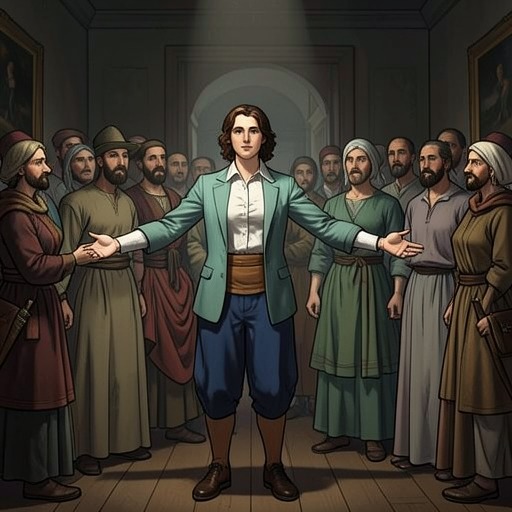
The principle receives a relatively clear application after Marcela defends her freedom to live apart and denies responsibility for Chrysostom’s death. When some of the assembled men appear ready to follow her as she leaves, Don Quixote intervenes. He orders them not to pursue her, argues that her account has shown her to be at little or no fault, and insists that she deserves respect rather than persecution. The immediate object of his protection is not a person asking him for rescue but a woman whose stated wishes others are inclined to disregard.
This episode places the duty beside a defense of Marcela’s right to choose her own life. Don Quixote’s intervention supports her declared refusal of her suitors and attempts to prevent the crowd from turning grief over Chrysostom into a claim upon her. The men remain where they are while the burial is completed. His chivalric language is extravagant, but here its practical result is restraint: he uses his authority as a knight to prevent pursuit rather than to impose his own wishes on Marcela.
The Inn and the Limits of His Judgment
At an inn, Don Quixote offers to repay his host by avenging any wrong done to him. He describes aiding the weak, avenging the wronged, and punishing treachery as his calling. The host, however, asks not for vengeance but for payment for the lodging, food, and provisions supplied to Don Quixote and his animals. Don Quixote has mistaken an ordinary inn for a castle, and his offer does not address the debt the host identifies.
The exchange shows a gap between the breadth of the knight’s stated mission and his attention to the concrete circumstances before him. His readiness to answer injustice with force does not ensure that he has correctly recognized what is owed or what remedy is needed. The scene does not cancel the ideal of assistance; it demonstrates how the ideal can become detached from practical obligations when Don Quixote interprets events through chivalric expectations.
The Galley Slaves and the Conflict with Law
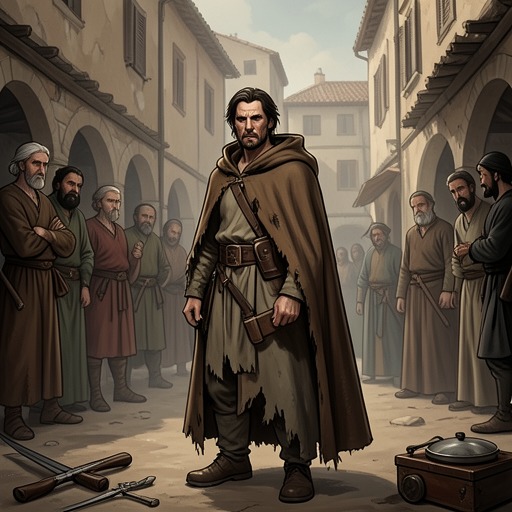
The sharpest conflict arises when Don Quixote and Sancho Panza encounter a chain of roughly a dozen men being escorted under guard to the galleys by royal order. Sancho identifies them as galley slaves and points out that they are being punished for their crimes, not wrongfully forced into service. Don Quixote nevertheless treats their unwilling journey as a possible occasion to aid the wretched. He asks the guards to explain the men’s individual cases, rather than accepting the escort’s general account as sufficient.
After listening to the prisoners, Don Quixote reasons that their punishments may have followed from several different disadvantages: one man’s failure under torture, another’s lack of money, another’s lack of legal advocacy, or a judge’s perverse decision. He does not establish that every prisoner is innocent; instead, he treats the possibility of unequal or defective justice, together with their lack of freedom, as grounds for intervention. He first asks the guards and commissary to release them peacefully, arguing that it is a harsh injustice to make slaves of people born free. When he anticipates refusal, he threatens to compel it with his lance and sword.
The intervention turns the duty into a direct challenge to royal authority. Later, an officer recognizes Don Quixote from a warrant issued by the Holy Brotherhood for his role in freeing the galley slaves and seizes him. The rescue thus has a legal consequence: the institution whose rules Don Quixote set aside now seeks his arrest. The episode preserves the force of his concern for suffering and freedom while making clear that good intentions alone do not resolve questions of guilt, procedure, or jurisdiction.
Meaning and Tension
Across these episodes, the duty moves between protection, misrecognition, and defiance. In Marcela’s case, Don Quixote acts against an imminent attempt to pursue a woman who has rejected her suitors; at the inn, his grand promise of redress overlooks the straightforward claim for payment; with the galley slaves, he substitutes his own assessment of their circumstances for the judgment embodied in a royal sentence. These differences matter: the rule is not simply that a knight should use force whenever someone suffers, but that Don Quixote repeatedly decides for himself who needs aid and what justice requires.
The novel therefore gives the chivalric obligation genuine ethical appeal without treating it as a reliable legal procedure. Don Quixote’s defense of the vulnerable can protect a person’s freedom, but his confidence in his vocation can also lead him to disregard evidence, obligation, and lawful authority. The duty supplies his adventures with a recurring purpose, while the varied outcomes reveal the difficulty of turning an absolute ideal of rescue into sound judgment in a complicated world.